NFO dispute process
The National Financial Ombud Scheme (NFO) South Africa is an independent, free alternative dispute resolution body for complaints against participating banks, insurers, and credit providers. Established in March 2024 through amalgamation of the banking, credit, long-term, and short-term ombuds, it offers a single entry point for most financial disputes.
0860 800 900 · WhatsApp · info@nfosa.co.za · Submit online →
Life Insurance Division
For disability and income protection claimants, the Life Insurance Division is the relevant route. ClaimBuddy's five essential principles article and the dispute resolution explainer below show how to structure evidence around policy definitions, causation, and procedural fairness before and during escalation.
Life Insurance Division
Focus: Long-term policies: life cover, dread disease, disability, income protection (GIP), funeral, health, credit life, and hospital plans.
Common issues: Own/any occupation definitions, pre-existing limitations, benefit calculations, declined claims, lapsed policies, beneficiary disputes, and procedural fairness.
Non-life Insurance Division
Focus: Motor, household, travel, and other short-term insurance products.
Common issues: Claims repudiation, excess disputes, valuation, and cover interpretation.
Banking and Credit divisions
Focus: Banking services, non-bank credit, and credit bureau listings.
Common issues: Account disputes, fraud, lending decisions, and bureau accuracy.
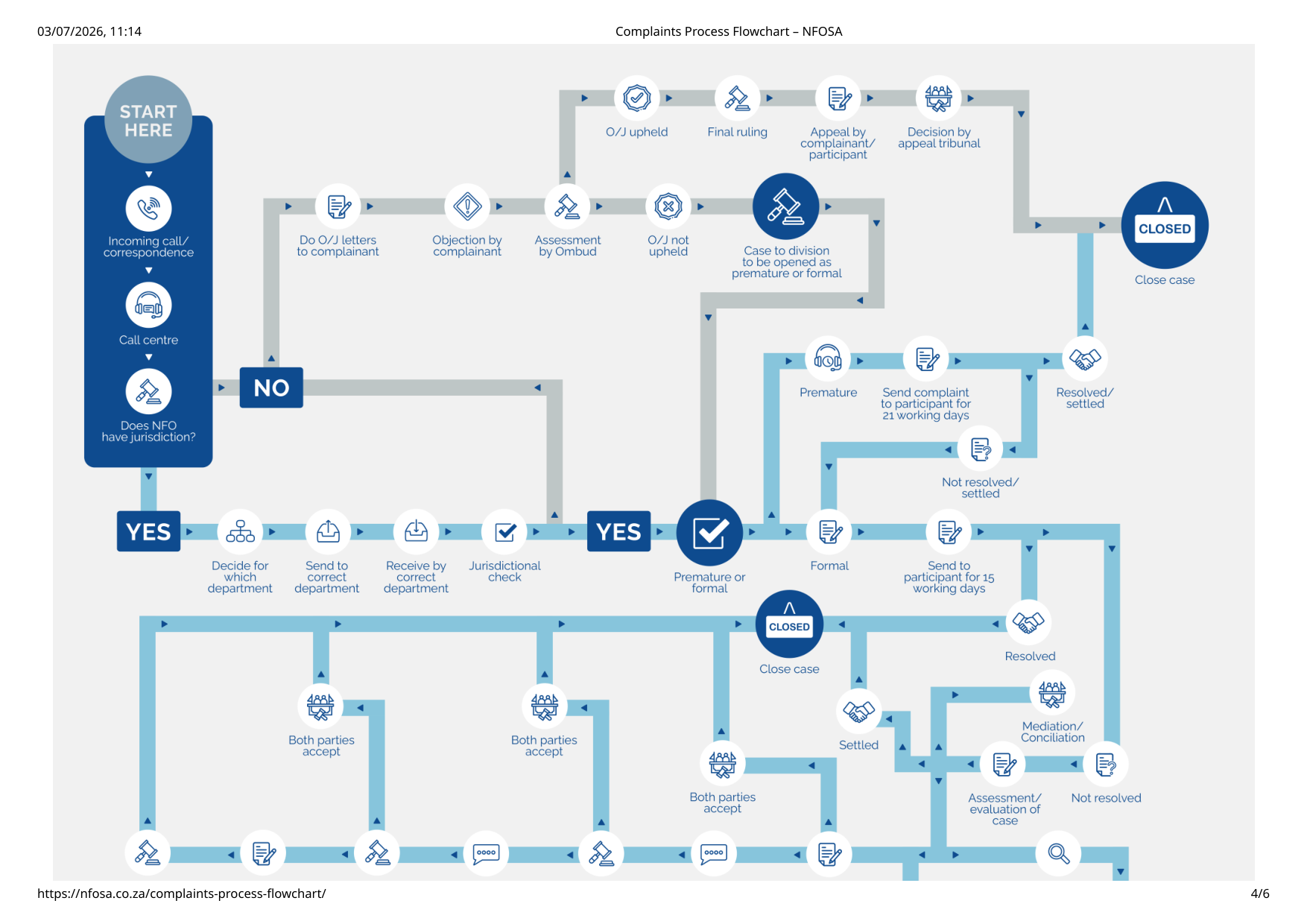
Complaints process flowchart
Official NFO infographic — click to enlarge. Source: nfosa.co.za/complaints-process-flowchart
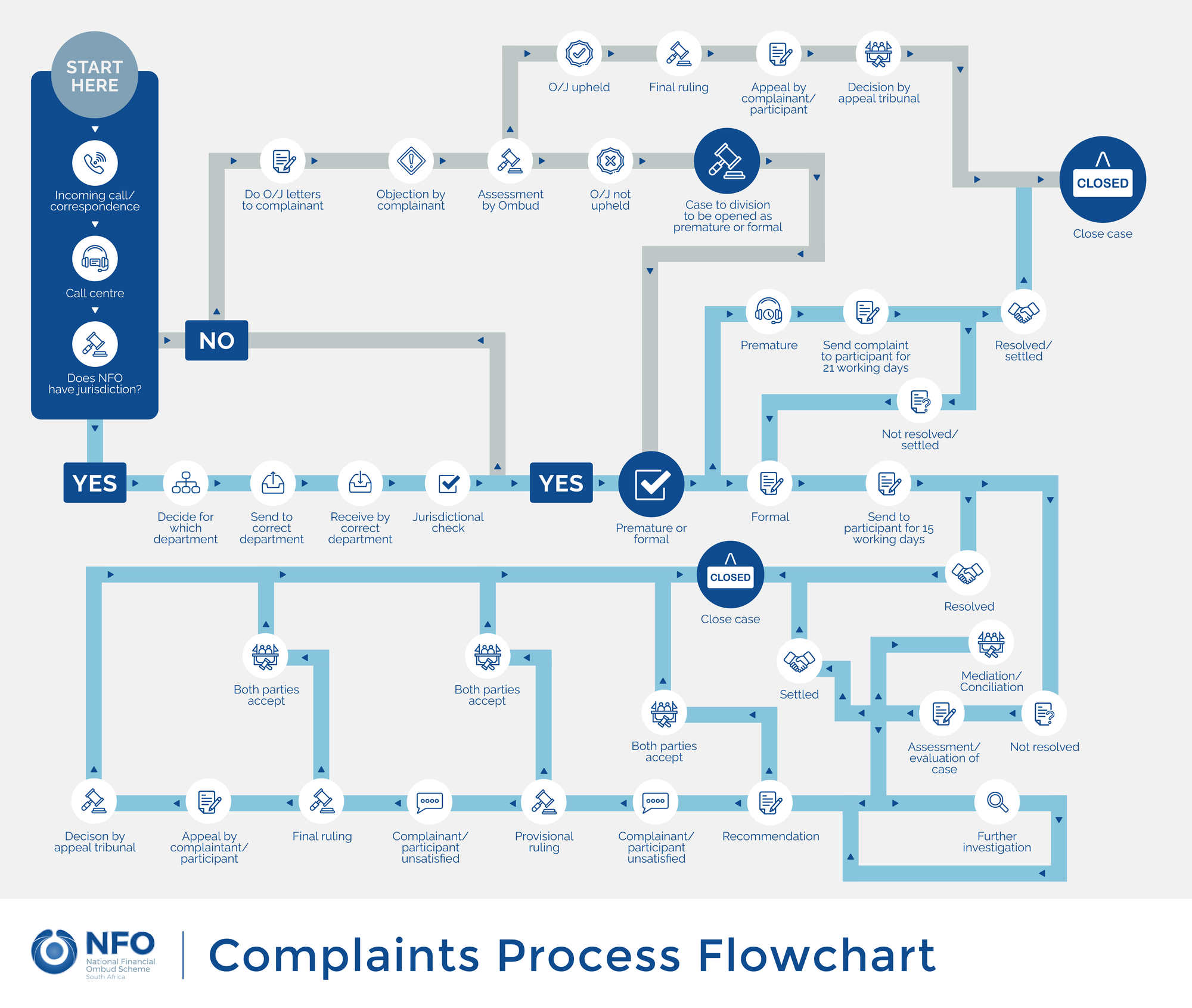
Seven-step process
-
1 Contact your Financial Services Provider first
Before submitting to the NFO , complain to your insurer in writing. You need a written internal decision with reasons if escalation is required.
Insurers must have an internal complaints process. Under the Policyholder Protection Rules , claims must be decided in a reasonable period with written notification of repudiation or dispute. Keep all correspondence — the NFO will ask for it.
TIP: Use the Document Vault (start a claim workspace) to store insurer letters, claim forms, and medical correspondence before you escalate to the NFO.NFO note: Mandatory first step — transfers without prior insurer contact are referred back.
-
2 Submit your complaint to the NFO
Online form (preferred), phone, WhatsApp, email, post, or walk-in. Free service in any official language.
Provide participant name, policy/account number, contact details, factual summary, and copies of all relevant correspondence and supporting documents. Written mandate required if a representative acts for you.
NFO note: Acknowledgement typically within one week.
-
3 Acknowledgement and initial assessment
Jurisdiction confirmed; vulnerable complainant support offered; insurer notified.
The NFO logs the complaint, confirms it falls within scheme rules, and requests the participant's full response and claim file. Vulnerable complainants may receive assistance completing forms.
NFO note: Once lodged, correspond with the NFO unless told otherwise (except during insurer transfer).
-
4 Investigation and information gathering
Both parties submit evidence; NFO reviews policy terms, records, and regulatory compliance.
For disability and income protection claims, the Life Insurance Division examines whether medical evidence maps to the policy's disability definition and whether causation and materiality were fairly assessed.
NFO note: The NFO may request further i nfo rmation from either party at any stage.
-
5 Mediation / conciliation
Settlement discussions facilitated between complainant and participant.
Many life insurance disputes resolve here. The Life Insurance Division has recovered substantial benefits for consumers on previously declined claims through mediated settlements.
NFO note: Confidentiality rules apply while the complaint is under investigation.
-
6 Formal determination or ruling
Provisional then final findings — recommendations, settlements, or binding rulings where appropriate.
If mediation fails, a formal investigation concludes with a provisional determination. You may respond with concerns before a final determination. Leave to appeal is limited and not a full rehearing.
NFO note: No strict monetary cap on most life insurance complaints.
-
7 Closure and tracking
Complaint closed; track status online; complex medical cases may take longer.
Simple matters may resolve in weeks to a few months. Disability cases with causation disputes or specialist evidence often require extended review. Continue paying premiums unless the insurer agrees otherwise.
NFO note: Feedback provided when there is something new to report.
Process detail panels


FAQ highlights
- When can I submit a complaint?
- After you have raised the complaint with the insurer and they have not resolved it to your satisfaction. Complaints not previously seen by insurers are transferred to them first (six-week response period).
- Does it cost anything?
- No — the service is free to complainants. Insurers pay case fees and an annual levy.
- Is there a claim amount limit?
- No monetary limit on life insurance complaints handled by the Life Insurance Division.
- Can I use my own language?
- Yes — you may correspond in any official language.
- Who pays for medical reports?
- You pay for medicals to prove your claim. If the insurer relies on an exclusion clause, the cost of additional medical reports is borne by the insurer.